Tuesday, May 7, 2019

Seti I’s Kom Ombo inscription mentions pharaoh Horemheb

 Image result for seti i mentions horemheb

by


Damien F. Mackey


What interests me with this is a thought of mine that Seti I may actually be Horemheb.

See my suggested comparisons between Horemheb and Seti I further on.


I do not accept at all the conventional dates given in the following article, which dates I believe are approximately half a millennium too high.


Ashley Cowie writes (2018):

https://www.ancient-origins.net/news-history-archaeology/kom-ombo-temple-0010793


Engraved Tablets Found at Kom Ombo Temple Reveal New Historic Trail to Horemheb


….


About 1289 BC Pharaoh Seti I became consecrated to the god Set and having founded the 19th dynasty he reigned for an estimated 55 years. Now, ancient carvings including ‘stone engravings and paintings’ have been found at Kom Ombo, a twin temple in southern Egypt, which are yielding new information about his relentless and highly-successful military campaigns in North Africa, and a lot more.


The Egyptian Ministry of Antiquities announced last week that their archaeologists had discovered the inscriptions while “conducting a groundwater-lowering project in Aswan” at the ‘twin’ or double temple at Kom Ombo. Situated about 30 miles (48 km) north of Aswan, Kom Ombo was built during the Graeco-Roman period between 332 BC and AD 395 and was dedicated to both the falcon-headed god Horus and a crocodile-headed god named Sobek, according to a report in Live Science .


An earlier temple at Kom Ombo


With its twin entrances, gateways and chapels, Kom Ombo was known to date back 2,300 years to the Ptolemaic Dynasty. But archaeologists believe that the recently found inscriptions may have originally been executed in “an earlier temple, now lost, at Kom Ombo” that was located on the same spot. Egyptologist Peter Brand, a professor of ancient history at the University of Memphis in Tennessee, told Live Science that one inscription depicts, “Seti I worshiping the gods Horus and a crocodile-headed god called Sobek and this is an exciting discovery and may be historically important.”


Image of Seti I, Sobek and Horus has been found at Kom Ombo. (Ministry of Antiquities)
….


Seti I is shown worshiping both Sobek and Horus, which Brand says:

“proves that the double cult of these two gods [Horus and Sobek] was already established at Kom Ombo in the 19th Dynasty of the New Kingdom period, more than 1,000 years [before] the later temple was built.”


Brand believes this was “a major royal inscription” containing data about the king's activities in the region, and “perhaps a dedication to the temple of Horus and Sobek [at] Kom Ombo.”

A second, larger inscription and image was discovered which belongs either to Seti I or to Ptolemy IV (expert opinions are not currently in agreement on which), while part of a third smaller inscription was found to have “yellow paint” despite the ravages of 3,300 years of passing time.


Large inscription could also be of Seti from the 19 th Dynasty. (Ministry of Antiquities)

…. 


Bringing 1000 years more history to the site


These inscriptions begin to make sense when we consider other images of Seti discovered at a site to the north of Kom Ombo called Gebel es-Silsilah. Brand suggests Seti was possibly “traveling through his realm in Year One [of his reign]” making stops at temples on his way south from Thebes (modern  Luxor) and he added that "Seti came from a family of military generals, and after he became pharaoh, he launched military campaigns to conquer Libya,  Canaan, Syria and  Nubia."

….


Inscription and image of Seti or Ptolemy with Horus. (Ministry of Antiquities).
….


Horemheb, the General King


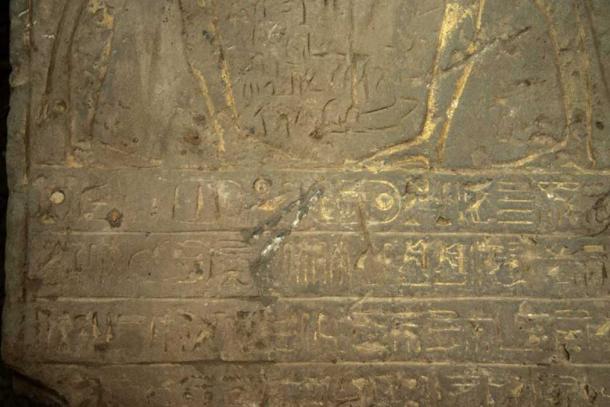
According to an article about the discovery in Egypt Today, the inscriptions, including “drawings and hieroglyphs,” not only tell of Seti I and Ptolemy IV but most interestingly to archaeologists, one of the inscriptions mentions “a powerful general in  King Tut's  army.” Aidan Dodson, an Egyptology professor at the University of Bristol noticed that the larger inscription at Kom Ombo mentioned Pharaoh “Horemheb,” who ruled up to around 1293 BC (the last pharaoh of the 18th Dynasty) and Dodson told Live Science that Horemheb “was in fact the highest general in King Tut's army during Tut's reign.”


Inscription under the Seti image mentions Horemheb. (Ministry of Antiquities)
….


With unknown parentage Horemheb is believed to have been a commoner who originated from Herakleopolis Magna (ancient Hnes, modern Ihnasya el-Medina ) on the west bank of the Nile near the entrance to the  Fayum, evident in that his coronation text formally credits the God Horus of Hnes for establishing him on the throne. As commander in chief of the army under the reign of  Tutankhamun and Ay, after his accession to the throne , Horemheb reformed the Egyptian state and took action against the preceding, troublesome and divisive, Amarna rulers. He not only demolished monuments of Akhenaten, reusing them in his own building projects, but he also toppled monuments of Tutankhamun and Ay .


With his tongue fixed firmly in his cheek, Ronald Leprohon, professor of Egyptology at the University of Toronto, told Live Science that Horemheb “became king by marrying into the royal family, and being head of the army probably also didn't hurt his chances of becoming pharaoh, either.” ….

[End of Ashley Cowie article]


Comparing Horemheb and Seti I


The following is taken largely from N. Grimal’s A History of Ancient Egypt (Blackwell 1994).


P. 242:


“[After Amarna]. A new man was needed if a new start was to be made. As is often the case in such circumstances, it was a military man … the commander-in-chief of the army … who took charge. The general Horemheb … began his career under Tutankhamun …. At that stage he was royal spokesman for foreign affairs”.


P. 246:


“When Sethos [Seti] I succeeded to the throne he had already been closely linked with the kingship … he held an office similar to vizier and also acted as the general in charge of foreign policy”.


Some similar buzz words (concepts) here: close to king; general (military); foreign affairs.

We can also add to this the word, vizier, considering that: “Horemheb was a diplomat and administrator who even held the exalted post of Vizier before becoming pharaoh”:


That the reign of Seti I constituted, like Horemheb’s, “a new start”, is attested by the fact that Seti I inaugurated a wehem meswet: That Sethos I did occasionally use an whm ms•wt dating we know from one of his inscriptions at Karnak…”:


The wehem meswet signified a “Renaissance”, or restoration.

It is not surprising, then, to find that: “Tutankhamun declared a wehem mesut, and it seems Horemheb may have as well”:


P. 243:


“Horemheb was above all the restorer of established order, as his royal titulature indicates”.


P. 246:


“[Seti I] also pursued a policy of restoration in home affairs and thus effectively rewrote history so as to legitimize his own dynasty”.


P. 243:


[Horemheb’s] Horus name is ‘Powerful bull with wise decisions’. The verb employed here is seped, a technical term describing the process of putting things in order …. Horemheb’s Golden Horus name was along the same lines, ‘He who is satisfied with Truth and who causes the Two Lands to increase’. Here again the verb herw, translated here as ‘satisfy’, has a precise judicial sense linked to the enforcement of law. The restoration of order was closely connected with the process of physical reconstruction, which was evoked in his Two Ladies name: ‘With countless miracles in Karnak”.


Pp. 246-247:


“The desire to uphold the power of Thebes was apparent in [Seti I’s] titulature: his Horus name was ‘Powerful bull who gives life to the Two Lands after having been crowned in Thebes”. He chose as his two ladies name. ‘The strong-armed one who renews birth and captures the Nine Bows’; but the legacy of the Amarna period still represented a heavy burden. Activities in Asia had been resumed under Horemheb. …. But the whole of Palestine was still hostile to Egypt”.


P. 246:


“[Seti I] depicted himself and his son and successor (Ramesses II) adoring the cartouches of previous pharaohs …. All of the Amarna kings had been removed from the record”.


P. 243:


“Horemheb was certainly a prolific builder: at Medinet Habu he enlarged a mortuary temple from Ay for his own use and at Gebel el-Silsila he dedicated a rock temple to Amun and Thoth. He also confirmed the importance of Memphis by setting up buildings in the precinct of the temple of Ptah and the sun temple at Heliopolis. But it was to Karnak that he devoted most of  his energies, as his choice of Two Ladies name suggests. He began on the Great Hypostyle Hall at Karnak”.


P. 244:


“Horemheb’s tomb (KV57) preserved the memory of the Amarna period in the depiction of clothing and in its unusual artistic style, but it was innovative on a technical level in the use of sunk relief instead of painting on plaster or a coat of gypsum. He also introduced new subject matter into his tomb, including the first example of the Book of Gates, which was to become one of the great royal funerary texts of the Ramessid period”.


Seti I also used sunk relief: “Combination of sunk/raised relief in the murals of façades: A - Sunk relief and combination of sunk/raised relief in the temple of Seti I …”:


P. 249:


“Apart from the unusually high aesthetic standard of its reliefs, the temple of [Seti I] at Abydos provides the basic nature of the royal mortuary temple …”.


P. 250:


“… the western walls are decorated with extracts from the Book of Gates”.


Sunday, May 5, 2019

Smendes and Shoshenq I


Smendes portalpesquisacomwpcontentuploads201502Smen


 by


Damien F. Mackey


With “Shishak” properly identified by Dr. I. Velikovsky … with Thutmose III,

the mighty pharaoh of Egypt’s Eighteenth Dynasty … then pharaoh Shoshenq I

must needs be lifted right out of the C10th BC and located some centuries later.


Conventional dates for Smendes, considered to have been the first ruler of the 21st Dynasty, are c. 1069-1043 BC.

Conventional dates for Shoshenq I, considered to have been the first ruler of the 22nd Dynasty, are c. 945-924 BC.


In terms of biblical chronology, Smendes would probably have been a younger contemporary of Samuel; whilst Shoshenq I has famously been identified (e.g. by Jean François Champollion) as the biblical “Shishak king of Egypt” at the time of King Rehoboam (I Kings 4:25-26).


However, I have – along with other revisionists – rejected Champollion’s view of Shoshenq I as “Shishak”:


Shoshenq I.

A (i): Who Shoshenq I was not


With “Shishak” properly identified by Dr. I. Velikovsky (as I believe) with Thutmose III, the mighty pharaoh of Egypt’s Eighteenth Dynasty:


Thutmose III best candidate for “Shishak”


then pharaoh Shoshenq I must needs be lifted right out of the C10th BC and located some centuries later.

So significant a chronological shift must also impact upon Smendes who would also need to be lowered down the time scale.

But then we start to get that awful crush of Third Intermediate Period (TIP) dynasties, 21-25, with which revisionists have to contend.


The Third Intermediate Period usually refers to the time in Ancient Egypt from the death of Pharaoh Ramesses XI (reign 1107–1078/77 BC) during the Twentieth Dynasty to the foundation of the Twenty-Sixth Dynasty by Psamtik I in 664 BC, following the expulsion of the Nubian rulers of the Twenty-Fifth Dynasty.


Smendes, apart from being considered as the founder of the 21st dynasty, is also thought to have been the first ruler of TIP.


A possible solution to early TIP would be to identify Smendes with Shoshenq I of supposedly a century later.

That there was a degree of similarity between Smendes and Shoshenq I is apparent from this quote from N. Grimal (A History of Ancient Egypt, Blackwell 1994, p. 332): “Shoshenq I immediately sought to prove that his claim to the throne went back to the preceding dynasty, and did so by adopting a set of titles based on those of Smendes I”.


Names shared: Meryre; Sekhempehti; Hedjkheperre-setpenre


Similarity can – but does not always – mean identity.

However, it is at least worth considering that Smendes and Shoshenq I were one and the same, with the possibility of aligning dynasty 21 with 22 to overcome at least some of the dynastic crushing of TIP.


Part Two: Smendes so poorly attested


“… most of what we know of Smendes predates his rise to the throne”.


“… we can only guess at Smendes' origins”.


“… there is a great deal of confusion concerning the origin of Smendes”.


 Jimmy Dunn


Statements like the above from Jimmy Dunn (Tour Egypt) would suggest that pharaoh Smendes, said to have reigned for as many as 26 years, may be sorely in need of an alter ego – with Shoshenq I being my suggestion for another face of Smendes. 


Smendes, the First King of the 21st Dynasty


and the Third Intermediate Period


….


Smendes (Smedes), who we believe founded the 21st Dynasty, ending the New Kingdom at the beginning of the Third Intermediate Period, is a very difficult individual with almost intractable origins and affiliations. His reign, which Manetho assigns 26 years, produced only a tiny handful of monuments and we have never discovered either his tomb or his mummy (though many believe his tomb to be NRT-I at Tanis, this structure offers up no clues concerning Smendes).


Smendes is a Greek rendering of this king's name. His birth name and epithet were Nes-ba-neb-djed (mery-amun), meaning "He of the Ram, Lord of Mendes, Beloved of Amun". His throne name was Hedj-kheper-re Setep-en-re, meaning "Bright is the Manifestation of Re, Chosen of Re".


In fact, most of what we know of Smendes predates his rise to the throne. From the Report of Wenamun, dating to Year 5 of the "Renaissance Era" during the last decade of the reign of Ramesses XI, we learn much of what we know of this future king. While on the way to Lebanon to obtain wood for the renewal of the divine barque of Amun-Re, Wenamun stopped at Tanis, which he describes as "the place where Smendes and Tentamun are". Smendes is specifically described as being the one to whom Wenamun gave his letters of credence from Herihor, the High-Priest of Amun and a powerful general in the south. Wenamun was then sent in a ship by Smendes to Syria. Smendes, along with Herihor and others, was cited as having contributed money to this expedition.


Smendes, together with Tentamun, are therefore shown to be of great importance in Egypt's Delta, equals at least of the High-Priest of Amun in the south. Consider the fact that Ramesses XI at this time presumably lived at Piramesses, only about 20 kilometers to the southwest of Tanis, and yet Wenamun came to Smendes for assistance rather than to the king. In fact, Herihor assumed some royal titles even while Ramesses XI was still alive, and the implication would seem to be that Smendes had a similar standing in the north.


Nevertheless, we can only guess at Smendes' origins. It has been suggested that he was a brother of Nodjmet, the wife of Herihor, but it has also been suggested that Nodjmet could have been a sister of Ramesses XI. However, Tentamun, who was presumably Smendes' wife, may have been a member of the royal family. She could have been a daughter of another woman named Tentamun, who may have been the wife of Ramesses XI (or possibly another Ramesside king). The older Tentamun was certainly the mother of Henttawy, who later became the wife of the High-Priest of AmunPinedjem I, who also acquired kingly status in the south. As a royal son-in-law, Smendes' status is more easily understood, though perhaps not his total eclipse of the king.


Obviously there is a great deal of confusion concerning the origin of Smendes. Nevertheless, it is very probable that the families of Smendes and Herihor, or at least their descendants, were linked.


Whatever his original status, after the death of Ramesses XI, Smendes became a king of Egypt, and is recorded as such in most reference material. However, only two sources specifically name him as pharaoh, consisting of a stela in a quarry at Dibabia near Gebelein (Jebelein), and a small depiction in the temple of Montu at Karnak. Interestingly, while there are no known unambiguously dated documents from his reign, the contemporary High-Priests of Amun used year numbers without a king's name, and it is generally believed that, at least through year 25, these refer to Smendes' reign.


In fact, Smendes probably never ruled over a united Egypt as such, a condition which probably also existed at the end of the reign of Ramesses XI. During much of what we refer to as the 21st Dynasty, there was also a dynasty of High-Priests of Amun at Thebes who effectively ruled Upper Egypt, while the kings at Tanis ruled the north. However, there appears to have been a rather delicate balance of powers, and perhaps even a formal arrangement for this division of Egypt. The Priests at Thebes seem to have held sway over a region which stretched from the north of el-Hiba (south of the entrance to the Fayoum) to the southern frontier of Egypt, and their aspirations became apparent around year 16 of Smendes' reign, when Pinedjem I apparently began to take on full pharaonic titles, yet at all times he continued to defer to Smendes as at least a senior king.


….


Part Three:
May Psusennes I and II be the actual same person?


“On the Dakhleh Stela of the Twenty-second Dynasty reference is made to
the 19th year of ‘Pharaoh Psusennes’. …. As Gardiner observes, one cannot determine
from this statement whether Psusennes I or II is intended”.
 
Beatrice L. Goff


If our suspicion in this series that Smendes of the 21st Egyptian dynasty was the same pharaoh as Shoshenq I of the 22nd (Libyan) dynasty, then this is going to assist in the necessary curtailing of the troublesome Third Intermediate Period (TIP), so-called, of Egyptian history.   


It will the open the door for further shrinkage, enabling, for instance, for the Psusennes I at the time of Smendes to have been the same as the Psusennses II at the time of Shoshenq I – as some have already suspected. Conventionally, the 21st dynasty is set out something like this:


Kings
Years BCE

Smendes

1069-1043

Amenemnisu

1043-1039

Psusennes 1

1039-991

Amenemope

993-984

Osorkon the Elder

984-978

Siamun

978-959

Psusennes 2

959-945

http://looklex.com/e.o/x/t.gif

About three decades separate Psusennes I from Psusennes II.


Then follows the 22nd dynasty, commencing with Shoshenq I, a known younger contemporary of Psusennes (so-called II).


According to the following site:


some have been suggesting an identification of Psusennes I and II:


While some authors, including New Chronology followers claim that Psusennes I may actually be identical with Psusennes II, this is impossible because Psusennes II is clearly distinguished from Psusennes I by Manetho and is given an independent reign of 15 years in the author's Epitome. Moreover, Psusenness II's royal name has been found associated with his successor, Shoshenq I in a graffito from tomb TT18, and in an ostracon from Umm el-Qa'ab. This shows that Shoshenq I was Psusennes II's successor. In contrast, Psusennes I died almost 40-45 years before Shoshenq I's appearance as Chief of the Ma, let alone King of Egypt.

[End of quote]


Psusennes I died almost 40-45 years before Shoshenq I …” according to the conventional calculations.

But that would no longer apply if Smendes were Shoshenq I, and Psusennes I and II were also the same person.